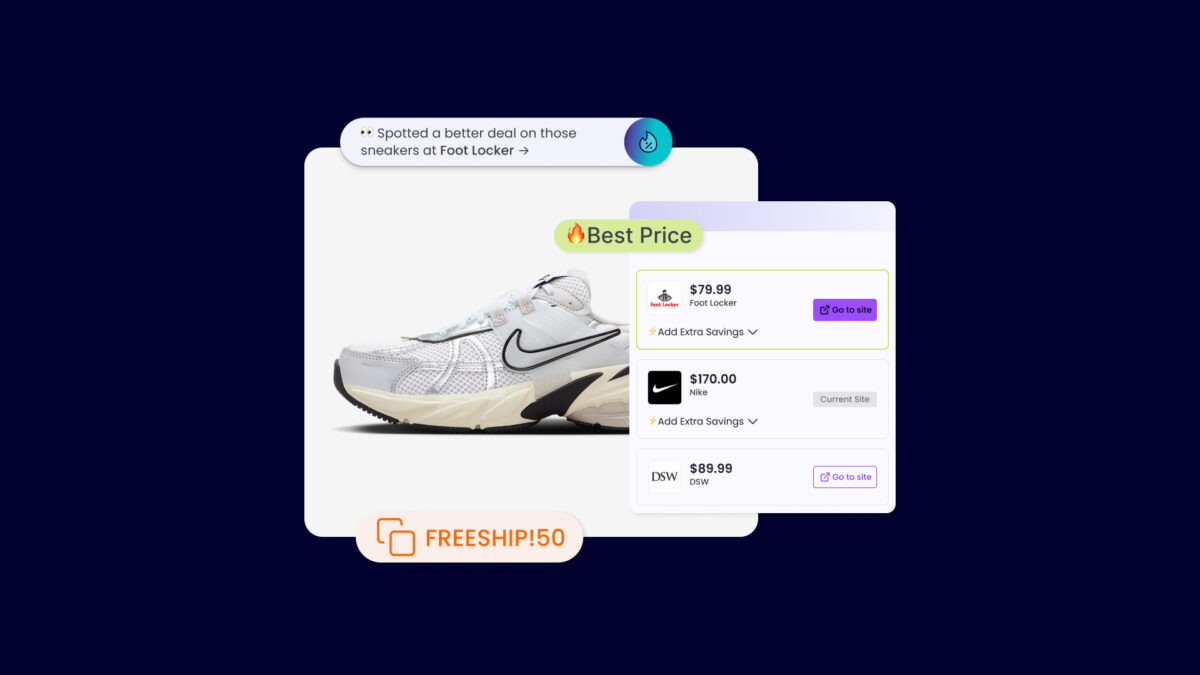
NEW YORK – December 10, 2025 – Appnomix, a Nomix Group company, today announced the availability of its new Agentic Commerce Development Kit (ACDK), a next-generation monetization framework that allows mobile app developers to earn guaranteed incremental revenue without altering their user experience. The ACDK combines Appnomix’s consumer-first commerce intelligence with expansive partner datasets to match users with better deals on the products they already want to buy.
Built on AI-driven intent modeling, the ACDK does not rely on coupon-clipping behavior or intrusive ad units. Instead, it improves the shopping experience by surfacing relevant savings at the moment a user is actively considering a purchase. Consumers continue browsing and shopping normally, while app publishers earn verified, incremental revenue in the background. Integration of the ACDK takes about four hours and requires no changes to the app’s design, user flow or navigation.
“Our goal is to redefine what commerce looks like,” said Colin Jeavons, CEO of Nomix Group. “With the ACDK, any developer can turn their app into a commerce-aware environment without pushing irrelevant offers or interrupting the user experience. It is passive, precise and built to deliver guaranteed revenue from the first day of integration.”
“With the ACDK, we wanted to eliminate the barriers that prevent most apps from participating in commerce,” said Ian Newfeld, CEO of Appnomix. “Developers should not need to negotiate merchant partnerships, build price comparison logic, or maintain their own product catalog. We deliver all of that through a single integration, and we guarantee publishers a baseline level of revenue.”
Early partner integrations indicate promising potential for incremental earnings and improved revenue per active user. Appnomix is actively working with apps reaching millions of monthly users and benefits from the broader Nomix Group ecosystem, which has influenced significant consumer shopping volume. The Appnomix ACDK is available today, with additional modules and features planned for release in early 2026.
For more information, visit appnomix.app.
About Appnomix
Appnomix provides mobile commerce infrastructure through its Agentic Commerce Development Kits (ACDKs), enabling app publishers to deliver branded shopping assistants that create loyalty without disrupting the user experience. By combining AI-driven commerce intelligence and extensive partner data, Appnomix helps apps surface relevant savings at the point of purchase interest, turning routine shopping into guaranteed incremental revenue opportunities. With seamless integration and a consumer-first approach, Appnomix supports publishers in growing revenue while maintaining brand integrity and a smooth user journey. Learn more at https://appnomix.app.
Contact:
Tony Winders
tony.winders@shopnomix.com
(818) 554-9236
App publishers face ongoing challenges with unpredictable ad revenue caused by market fluctuations, seasonal trends and changing user behavior. Relying solely on advertising puts your revenue at the mercy of factors beyond your control, making it difficult to plan, invest and grow with confidence.
Appnomix offers a straightforward solution that changes the equation: a branded AI shopping assistant
integrated via a lightweight Agentic Commerce Development Kit (ACDK) that helps your users find better deals when shopping online and guarantees you steady revenue in return. This approach makes an immediate impact on your earnings without disrupting your app or user experience.
Here’s How Appnomix Creates Value for Publishers
Guaranteed Minimum Revenue Plus Revenue Sharing Every publisher that integrates Appnomix’s commerce infrastructure is guaranteed a minimum payment per active user per year. On top of that guaranteed floor, publishers earn 70% of all revenue generated through the shopping assistant, creating meaningful upside beyond the minimum. Your revenue floor is contractually secured, and the growth potential remains fully with you.
How It Works: Simple Steps to Revenue
ACDK Integration: Appnomix provides a lightweight Agentic Commerce Development Kit (ACDK) for you to embed into your app. This kit enables a browser extension-style AI shopping assistant fully branded for your app, maintaining your native look and feel.
Baseline Measurement: Over an initial 8-week period, the ACDK collects user engagement and revenue data. This phase is passive and does not require any changes to your existing monetization stack.
Guaranteed Revenue Established: Using real data from the baseline period, Appnomix sets a custom guaranteed minimum payout per active user per year, and a 70% revenue share. You earn this predictable revenue every month, with no caps.
Ongoing Earnings and Growth: As your users engage with the shopping assistant, you earn above the guaranteed minimum based on actual spend and savings activity, creating a new, consistent revenue stream without additional risk or disruption to your current demand.
User Experience and Publisher Control
Your branded AI shopping assistant operates like a browser extension to help your users shop smarter by showing them deals and discounts on products they already want as they shop across the mobile web. Once they opt into the program from your app, the shopping assistant immediately starts bringing value to your audience, improving loyalty and satisfaction with your brand with minimal technical effort on your part.
Importantly, you retain full control over your app’s user experience, ad formats and placements. Appnomix’s ACDK and solution never disrupt existing monetization channels or introduce intrusive ads.
Why It Matters
Advertising revenue has long been unpredictable for app publishers. With Appnomix, you gain a reliable, transparent revenue floor based on your active users, regardless of external fluctuations.
Search used to be a gateway to websites. Now, more often, it’s the destination.
Ian Newfeld, CEO at Appnomix
In 2024, analysis from SparkToro estimated that about 58.5% of U.S. searches and nearly 60% in the EU ended without any click to the open web. One year later, Similarweb reported that after Google’s AI Overviews expanded, the share of searches with no external click rose from roughly 56% in May 2024 to about 69% by May 2025.
That sounds bleak—until you realize the fish didn’t disappear; they moved. If answers now live on the results page, retailers must cast their line where intent gathers—on the product detail page (PDP).
What Changed in Search
AI Overviews, Bing Copilot, and other answer-engine experiences have compressed the journey. Instead of “query → click → read,” users see a synthesized response at the top of the results page and often stop there or refine the question. This isn’t just interface polish; it’s a shift in incentives. Search engines are competing to satisfy intent immediately, which reduces friction for users but removes the handoff that once sent traffic to retailers.
Discovery hasn’t vanished; it’s happening inside the answer itself.
When a shopper stops at an answer card, their needs don’t evaporate. They still want confirmation of the exact model or fit, clarity on price and stock by fulfillment option, and—if the item isn’t available—the same product from an approved partner. That’s why the product page should behave like an answer surface: resolve the question in place with model confirmation, real-time price and availability, and identical-product alternatives, then convert.
Fish Where the Fish Are
Treat the product page as the answer surface you control. A lightweight Answer-AI on the PDP can confirm the exact model, resolve price/stock questions in the shopper’s context, and, when needed, surface same-product alternatives from partners without conquesting competitors. It mirrors how an answer card resolves a query—but on a surface where you can turn certainty into revenue and relationships.
Teach the Product Page to Answer Like an Expert
For years, product pages have been static showcases: images, specs, and buy buttons waiting for clicks. But in a world where shoppers expect instant clarity, a good product page must behave like an expert. It should recognize the question behind the visit, confirm the shopper’s intent, and respond with confidence.
That starts with identity. Each PDP needs to understand what it’s showing and who’s asking. When a visitor arrives from search, the page should instantly verify the SKU, model number, or variant that matched the query and return a short confirmation such as, “You’re viewing the 512GB model of the Galaxy S23 Ultra.” It’s the digital equivalent of a store associate double-checking that a customer picked up the right box.
Next, that confirmation should trigger context-aware data—live pricing, local availability, and delivery options—drawn from the same feed that powers merchant listings and partner catalogs. If an item is unavailable, the page should offer nearby pickup, back-in-stock alerts, or identical-product alternatives from approved partners, framed as service, not competition.
Every answer should be traceable. Displaying the data source the information came from—your feed, merchant center, or partner network—builds trust and keeps compliance simple. Finally, track what shoppers ask for most often: which confirmations, stock checks, or delivery clarifications happen repeatedly. Those insights become a roadmap for improving PDP content, refining your data pipeline, and tuning future AI responses.
Teaching the product page to answer like an expert isn’t about adding a widget; it’s about turning a passive display into an active dialogue that reassures, resolves, and converts.
How to Measure Success When Clicks Fade
Search engines now satisfy more shopper intent directly, which means traditional success metrics—clicks, sessions, referral traffic—no longer tell the full story. To understand how well your product pages perform, measure what happens after intent arrives.
Focus on indicators that reveal how effectively your PDPs resolve questions and guide decisions:
Model or variant confirmation rate — how often shoppers validate that they’ve found the exact product they were searching for.
Price and stock interaction rate — clicks, hovers, or expansions on availability data that show shoppers engaging with real-time information.
Add-to-cart and assisted conversions — sales or cart actions that occur after a shopper interacts with Answer-AI elements.
Time to decision — how quickly shoppers move from first interaction to cart or checkout once their questions are resolved.
Alternative product selection — frequency with which users choose an identical-model alternative when the original offer isn’t available.
These are outcomes you can directly influence inside your own ecosystem—measures of clarity, trust, and conversion that remain steady even as external traffic patterns shift.
Why This Framing Resonates with Shoppers
Those metrics matter because they mirror how people actually shop. Most shoppers don’t think in channels; they think in tasks: is this the right item, can I get it by Friday, is the same one in stock somewhere else. The winning product page feels like a capable clerk who answers quickly, not a billboard hoping for a click. When your page confirms the exact model, clarifies price and stock, and offers an identical alternative when needed, it aligns perfectly with those tasks—and lowers the effort required to buy.
The Net Effect
Zero-click isn’t an apocalypse. It’s a redistribution of attention toward answer-style experiences. When retailers bring those answers onto the product page, they stop waiting for referral traffic and start resolving intent where it still converts. The fish didn’t vanish; they changed ponds. Go cast there.
Monetizing the $1.3 Trillion Shift: How App Publishers Can Capture the Commerce Opportunity
The convergence of technology and retail is bringing forward new opportunities for app publishers to diversify their revenue streams with mobile commerce. Appnomix’s new AI-powered commerce infrastructure allows app publishers to improve both user experience and loyalty while also tapping into the lucrative world of e-commerce.
Understanding the Current Limitations of In-App Monetization
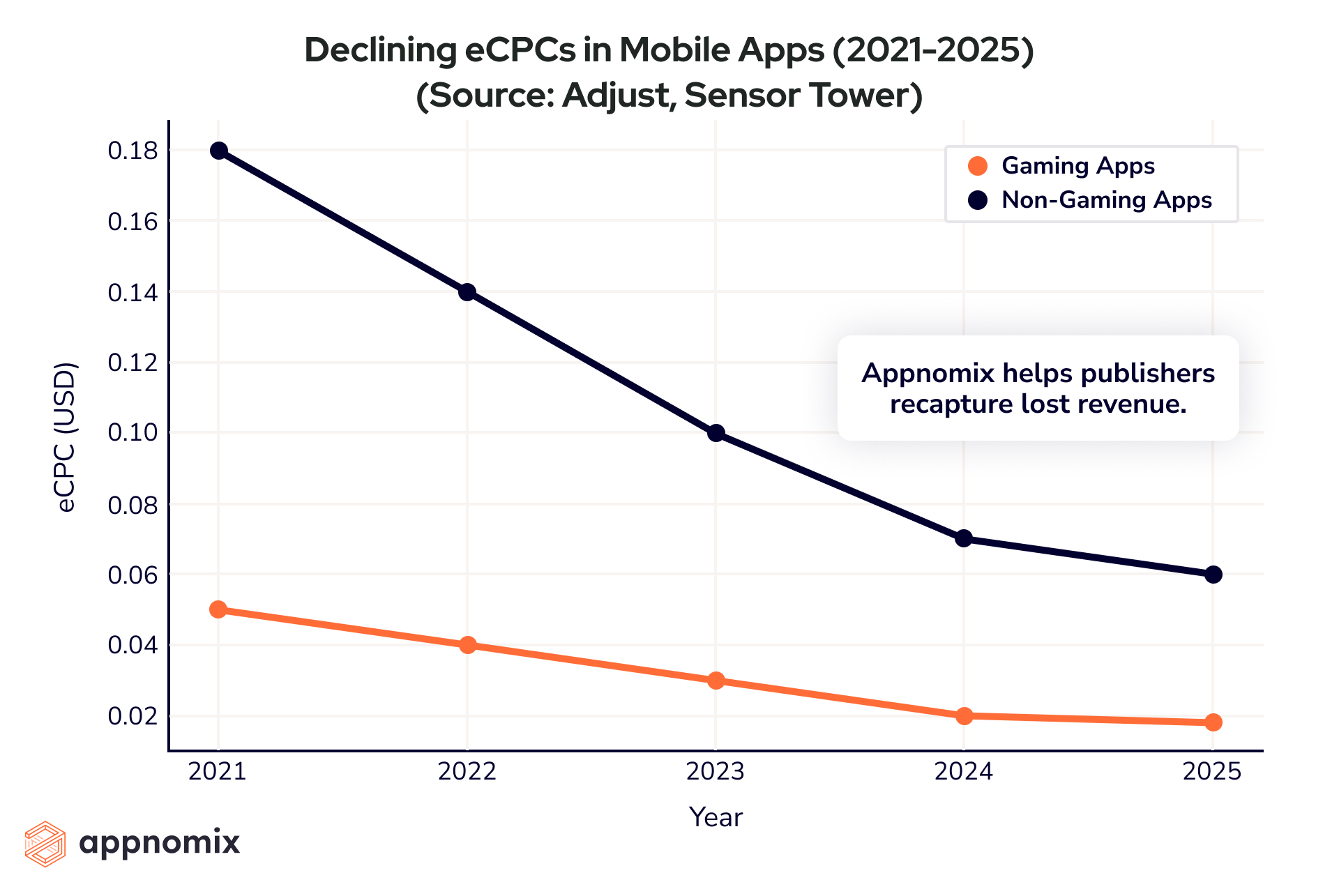
Many app publishers face challenges with traditional in-app monetization strategies. Advertising yields are under pressure: the average cost-per-click rose 16% in 2024, and customer acquisition costs have climbed nearly 60% over five years. At the same time, users are increasingly desensitized to ads and privacy restrictions have further weakened ad targeting. This makes ad revenue a shrinking piece of the monetization mix, and relying on ads alone can hinder growth.
The decline is clear in the latest benchmarks: Adjust reports that the global median eCPC fell from $0.04 in 2023 to $0.03 in the first half of 2024, a 25% drop. This mirrors the steady downward trend shown in the chart, underscoring how ad revenue has become a shrinking piece of the monetization mix.
Moreover, the current market dynamics suggest that app publishers are missing out on a substantial share of revenue. It is projected that North American e-commerce sales will reach about $1.3 trillion in 2025, with consumers averaging more than $2,000 annually in online spending. Collectively, this is spending that flows through mobile devices but largely outside of non-retail apps. Publishers have no participation in this revenue stream when their users leave their apps to shop. By adopting a more user-centric approach, they can redefine the in-app experience, foster loyalty and capture a portion of that spend.
The Scale of the Opportunity: Unlocking New Revenue Streams
Imagine the revenue potential for app publishers with turnkey access to a robust commerce infrastructure. With the integration of Appnomix’ AI-powered Commerce SDK, publishers can offer personalized shopping experiences that cater to individual user preferences. This not only enhances engagement but also encourages repeat visits and prolonged app usage. Additionally, by providing users with tailored recommendations and exclusive deals, publishers can create an environment that feels both rewarding and engaging.
Appnomix’ access to an extensive network of 50,000 merchants and over one billion products ensures publishers will always connect users with products aligned to their interests and needs. The ability to suggest relevant items enhances the overall user experience, positioning the app as a trusted resource rather than just a tool for a specific purpose.
Appnomix works by helping users discover the best prices and discounts as they shop the mobile web. Participation is activated inside of the app user flow, but the real value is created outside of the app experience itself. The result is increased revenue, brand loyalty and retention without disrupting user experience.
Integrating commerce into apps also presents an opportunity to deepen connections with users. By offering value beyond the app environment (e.g. loyalty programs, discounts and smart shopping assistance), publishers can foster a community of loyal customers. This shift not only increases satisfaction but also opens up a significant new revenue channel that has traditionally been inaccessible to app providers.
Real-World Examples in Commerce Integration
Consider a successful app like Spotify. With more than 50 million subscribers, retaining their user base is critical. With Appnomix’s commerce infrastructure and SDK, Spotify could extend its value by offering a branded shopping assistant to support its users across the mobile web.
For example, a Spotify subscriber shopping for television at Walmart.com might see a Spotify-branded assistant surface at checkout, offering smarter options:
“There is a better price for this television at Best Buy.”
“The item in your cart has a 25% off coupon today at Walmart.”
By making these types of intelligent, real-time recommendations, Spotify could deliver value for its users outside the app, foster brand loyalty, and capture commerce revenue that would otherwise go untapped. This is not just hypothetical. Appnomix is already active on millions of devices and is generating an average of between $3-12 in revenue-per-user annually. Developers are discovering this new way to generate revenue from out-of-app purchases without replacing ads or disrupting in-app user experience and monetization. It’s proof that commerce integration can be complementary, not cannibalistic to revenue growth.
The novelty and competitive advantage of integrating commerce into apps cannot be understated. As Ian Newfeld of Appnomix observed, “Giving users the ability to shop smarter across the mobile web and then capitalizing on those revenue opportunities is not something apps have traditionally done.”
By offering unique features that provide real value, app publishers can differentiate themselves, attract new users and retain existing ones, ultimately leading to increased revenue potential.
For app publishers ready to enter the world of commerce, the first step is to assess current offerings and identify gaps in value. Understanding user needs and preferences is critical. Publishers can conduct surveys, analyze user behavior and explore market trends to inform their strategy. Once a clear understanding of the target audience is established, it’s time to consider how to implement commerce features effectively.
Utilizing an AI-powered SDK, such as Appnomix, can streamline the integration process. The SDK enables publishers to offer personalized shopping experiences without overwhelming users with irrelevant options. With data-driven insights and AI, publishers can deliver curated product selections that resonate with their audience, enhancing satisfaction and driving conversions. Unlike ad networks experimenting with early-stage commerce ad formats, Appnomix’s infrastructure is designed for partnerships and branded value, not ad placements. That distinction matters: it allows publishers to extend their brand into the shopping journey instead of simply running ads for someone else.
With access to millions of data points related to product SKUs, pricing and availability, the SDK ensures consumers always have access to the best deals and discounts on a wide range of products and promotions. By aligning with reputable merchants, publishers can guarantee that users receive quality offerings, further elevating the app’s credibility. This partnership approach not only enriches the user experience but also establishes a source of income through affiliate commissions.
The Net Gain
Integrating commerce into apps is no longer a distant possibility; it’s a present opportunity for publishers willing to innovate. By providing additional value to users, publishers can create a compelling user experience that fosters loyalty and drives revenue. Embracing AI-powered commerce infrastructure will empower app publishers to stand out in a crowded marketplace, ensuring they are equipped for the future of mobile commerce.
If you’re ready to transform your app and explore the potential of commerce integration, consider connecting with Appnomix. Whether you’d like a demo or to discuss partnership opportunities, the path to enhancing user experience and unlocking new revenue channels starts right here. Let’s embark on this exciting journey together.